

Building swimming confidence in Singapore starts with understanding that water anxiety is not a personality flaw — it is a trainable skill. Whether you are an adult who has avoided pools for decades, a child who panics when feet leave the bottom, or a swimmer competent in calm water but anxious in unfamiliar settings, water confidence can be developed systematically with the right approach and a patient, qualified coach.
Understanding Water Anxiety: Types and Triggers
Fear of water is extremely common. Surveys consistently show a significant proportion of adults in Singapore have some degree of water anxiety, ranging from mild discomfort to a genuine phobia that prevents any water contact. For children, fears are often triggered by an unpleasant experience — unexpected submersion, a wave catching them off guard, or being placed in the water before they felt ready.
| Anxiety Type | What It Feels Like | Key Coaching Approach |
|---|---|---|
| Fear of submersion | Dread of face or head going under water | Gradual breath-control exercises; nose exhale practice at surface first |
| Fear of depth | Panic when feet cannot touch the bottom | Progressive depth exposure; back-float confidence in shallow first |
| Fear of loss of control | Panic when body moves unexpectedly | Floating practice; building trust in buoyancy before propulsion |
| Fear of drowning | Broad existential anxiety around water | Survival skill foundation (float, tread, call for help) before stroke |
| Performance anxiety | Fear of looking incompetent in front of others | Private 1-to-1 lessons; quiet condo pool environment |
The Core Principle: Competence Creates Confidence
The most reliable route to water confidence is developing genuine swimming competence. Confidence that is not grounded in actual skill tends to be fragile — it evaporates the moment something unexpected happens. Confidence built on solid floating ability, breath control, and basic self-rescue skills holds up even in challenging conditions.
This is why a good swimming coach does not try to talk an anxious swimmer out of their fear. They address it by systematically developing the skills that make the fear unnecessary. A swimmer who can float, control their breathing, and swim a short distance to safety is genuinely safer in the water — and their nervous system knows it.
How to Build Swimming Confidence: Step by Step
- Start at your comfort level, not the coach’s — even if that means standing in the shallow end with water at ankle level. Gradual, controlled exposure at the learner’s pace is more effective and more durable than rushed progression. A skilled coach at SwimmingCoach.sg will never push a nervous swimmer further than they are ready to go.
- Learn to float before learning to stroke — independent back-floating is the single most important water confidence skill. It is also the foundation of water survival: a person who can float can rest, breathe, and call for help without swimming. Many anxious swimmers find that the moment they float successfully on their own, their anxiety reduces substantially.
- Master breath control at the surface — slow continuous exhale through the nose while submerged, calm inhale at the surface. Once breath is no longer a source of anxiety, the other elements of swimming become dramatically more manageable. Adult swimming lessons focused on breath control are often the most transformative sessions anxious swimmers experience.
- Build success experiences deliberately — confidence in water grows through accumulated achievement. Each small step — putting your face in for three seconds, floating for ten seconds, kicking to the wall — adds to a growing track record that you can manage in water. A good coach structures lessons around achievable steps and aims to end each session on a constructive note.
- Increase depth gradually and on your terms — for swimmers anxious about depth, the progression from shallow to deeper water should be very gradual. The swimmer chooses when they are ready; they are never pushed. Most anxious swimmers find that once they can float and control breathing, depth becomes much less frightening — because they know what to do if their feet cannot touch the bottom.
- Practise between formal lessons — water confidence is like any skill: it diminishes with disuse. Regular pool time, even just 15–20 minutes at your condo pool, maintains and builds on what lessons develop. Your coach will suggest appropriate between-session activities for your level.
Common Mistakes When Trying to Build Water Confidence
- Rushing past anxiety to get to stroke technique — coaches who skip the confidence-building phase to teach freestyle produce swimmers who look like they can swim but freeze in unexpected situations.
- Using floaties as a confidence shortcut — inflatable armbands create the illusion of buoyancy without teaching the swimmer to create their own. They mask inability and can delay real confidence building.
- Avoiding the pool after a bad experience — the longer the gap after a frightening water experience, the more powerful it becomes. Returning to water sooner — in a controlled, supported way — is almost always better than prolonged avoidance.
- Group lessons for highly anxious learners — group dynamics add social pressure that compounds water anxiety. Private one-to-one lessons are strongly preferred for anyone with significant water fear.
Safety: What Not to Try When Building Confidence
Safety notice: Some swimmers, when trying to push through fear, attempt breath-holding drills — holding the breath while swimming underwater for extended distances. These drills carry a genuine risk of shallow-water blackout — loss of consciousness due to low blood oxygen, occurring without warning, even in experienced swimmers. Never practise breath-holding drills alone or without a qualified coach and a trained observer present. This risk is real and not proportional to swimming ability. SwimmingCoach.sg coaches do not use hypoxic drills in confidence-building or recreational lessons.
Building Water Confidence in Children
Children’s water confidence is built through exactly the same principles, adapted in style and language. Key guidelines for parents:
- Never force a child into the water. Forced exposure rarely builds confidence and frequently creates lasting anxiety.
- Model calm behaviour in the water yourself — children read parental water anxiety very quickly.
- Let children enter the water at their own pace initially; let them choose when to go deeper.
- Use positive framing. “The water is holding you up” is more helpful than “don’t be scared.”
- Celebrate every step, however small — a child who put their face in for the first time deserves genuine recognition.
- Choose a coach who understands anxious learners. Children’s swimming lessons with a patient, experienced coach make an enormous difference for nervous learners.
The Right Environment Matters
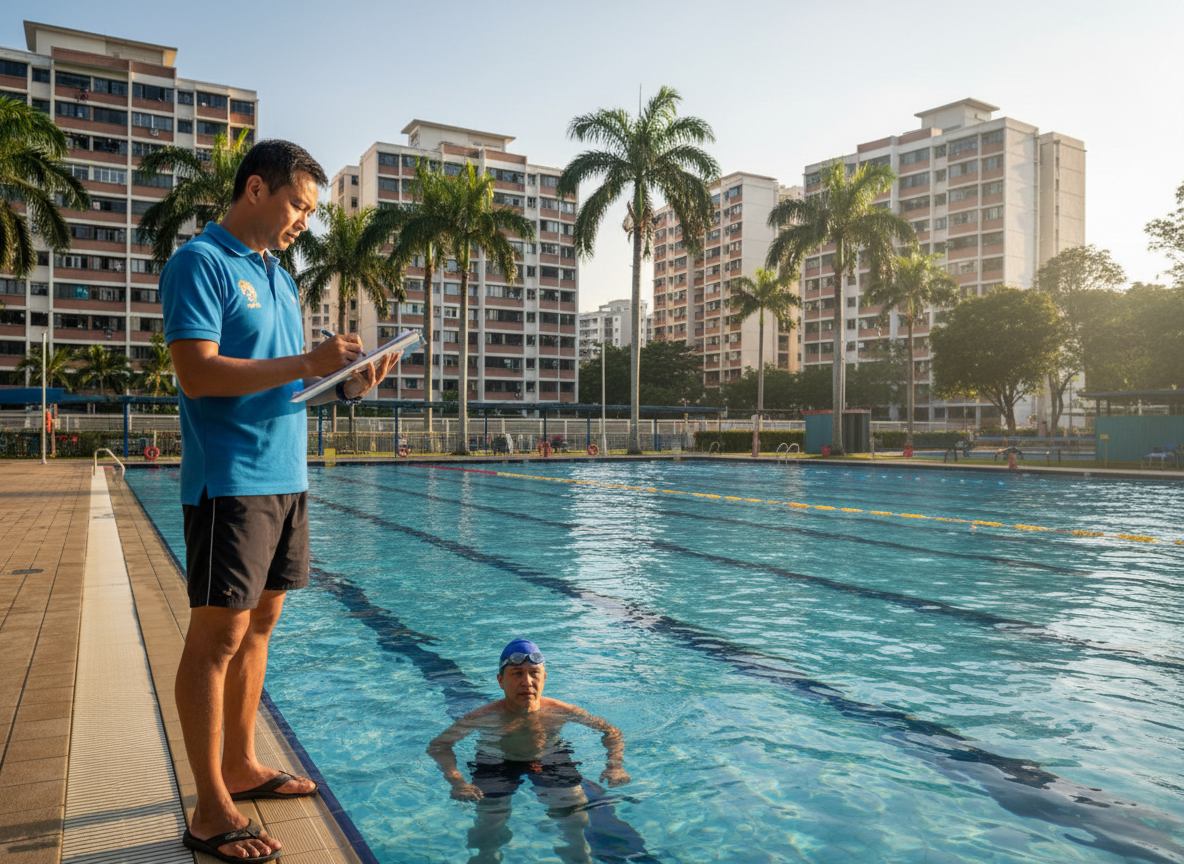
A crowded, noisy public pool with strangers splashing nearby is a challenging environment for anyone building water confidence from scratch. A quiet private pool at a familiar location reduces the baseline anxiety level before the lesson even begins. This is one of the practical reasons condo pool lessons are so effective for nervous swimmers: familiarity and quiet do a lot of the early work. For pool options across Singapore: swimmingcomplex.sg, swimmingnearme.sg, condoswimming.sg, privateswimming.sg.
More resources: singaporeswimminglessons.sg, swimmingclasses.sg, specialneeds.com.sg, swimminginstructorcourse.sg, swimschoolsinternational.sg.
Frequently Asked Questions
How long does it take to build water confidence?
It varies widely and cannot be predicted from a fixed session count. Progress depends on the learner’s starting anxiety level, lesson consistency, practice between sessions, and coaching approach. Gradual exposure and skill building produce more durable confidence than pressure or rushing.
Can adults truly overcome a long-standing water phobia?
Yes, frequently and sometimes surprisingly quickly. Adults who follow instruction and understand the logic behind each step often progress faster than expected. Many who considered themselves permanently water-phobic have become confident recreational swimmers within a few months of working with the right coach.
Should I tell my coach about my anxiety before the first session?
Absolutely. Knowing about your anxiety allows the coach to plan the session appropriately. Be specific about what frightens you — depth, submersion, losing footing — so they can address each element systematically rather than discovering mid-lesson that the approach needs changing.
Is it normal to make progress and then regress?
Yes. Non-linear progress is normal in any skill, particularly anxiety-related areas. An uncomfortable experience — water up the nose, an unexpected splash — can temporarily set things back. A good coach expects this and has strategies for recovering without making the regression feel like failure.
What is the best lesson format for an anxious swimmer?
Private one-to-one lessons are almost always the best setting for building water confidence. The absence of group pressure, the ability to set the pace completely, and the full attention of a qualified coach make private lessons significantly more effective for nervous learners than group classes.
Where can I find a patient coach for anxious swimmers in Singapore?
Contact SwimmingCoach.sg. We match anxious swimmers with coaches experienced in working with nervous learners of all ages across Singapore, at your condo pool or a suitable quiet venue.
Take the First Step
Water confidence is built one small step at a time. You do not need to overcome your anxiety before your first lesson — that is what the lessons are for. The only requirement is a willingness to show up and work at it gradually, with the right coach. Get in touch with SwimmingCoach.sg to arrange your first session today.


[…] Building swimming confidence […]