

By Alvin · SSI Swim Teacher Instructor, AustSwim Assessor, Autism Swim Teacher · More than 10 years coaching · Last updated: 21 October 2026
Swimming stroke correction identifies and fixes the specific technique faults holding you back in the water — poor body position, dropped elbow, crossed arm entry, lifted head to breathe — replacing them with efficient, propulsive movement. For recreational and fitness swimmers in Singapore, a targeted correction block often produces more speed improvement than months of additional training alone.
Why Technique Matters More Than Fitness in Swimming
In running or cycling, average technique still allows progress through harder training. In swimming, poor technique creates drag that no amount of fitness can fully overcome. A sinking hip, crossed arm entry, or lifting the head to breathe can add significant resistance per stroke. Correcting one major technique fault often produces a speed improvement that would otherwise take many months of additional fitness training to achieve.
This is why experienced swimmers from other sports — runners, cyclists, footballers — often find swimming disproportionately hard. Their aerobic fitness is excellent. Their drag is not. Stroke correction addresses the root cause directly.
Common Faults by Stroke: What Your Coach Will Look For
| Stroke | Most Common Fault | What It Costs You | Correction Priority |
|---|---|---|---|
| Freestyle | Lifting head to breathe | Hips sink, whole body drags | High — fix first |
| Freestyle | Arm crosses centreline on entry | Body snakes, wastes energy | High |
| Breaststroke | Sequential pull-then-kick (not simultaneous) | Loses glide, slows dramatically | High — most complex fix |
| Breaststroke | Feet splaying outward on kick | Reduces propulsion significantly | Medium |
| Backstroke | Lateral snaking from arm crossover | Direction drift, wasted effort | Medium |
| Backstroke | Insufficient hip rotation | Weak catch, short pull | Medium |
The Stroke Correction Process: Step by Step
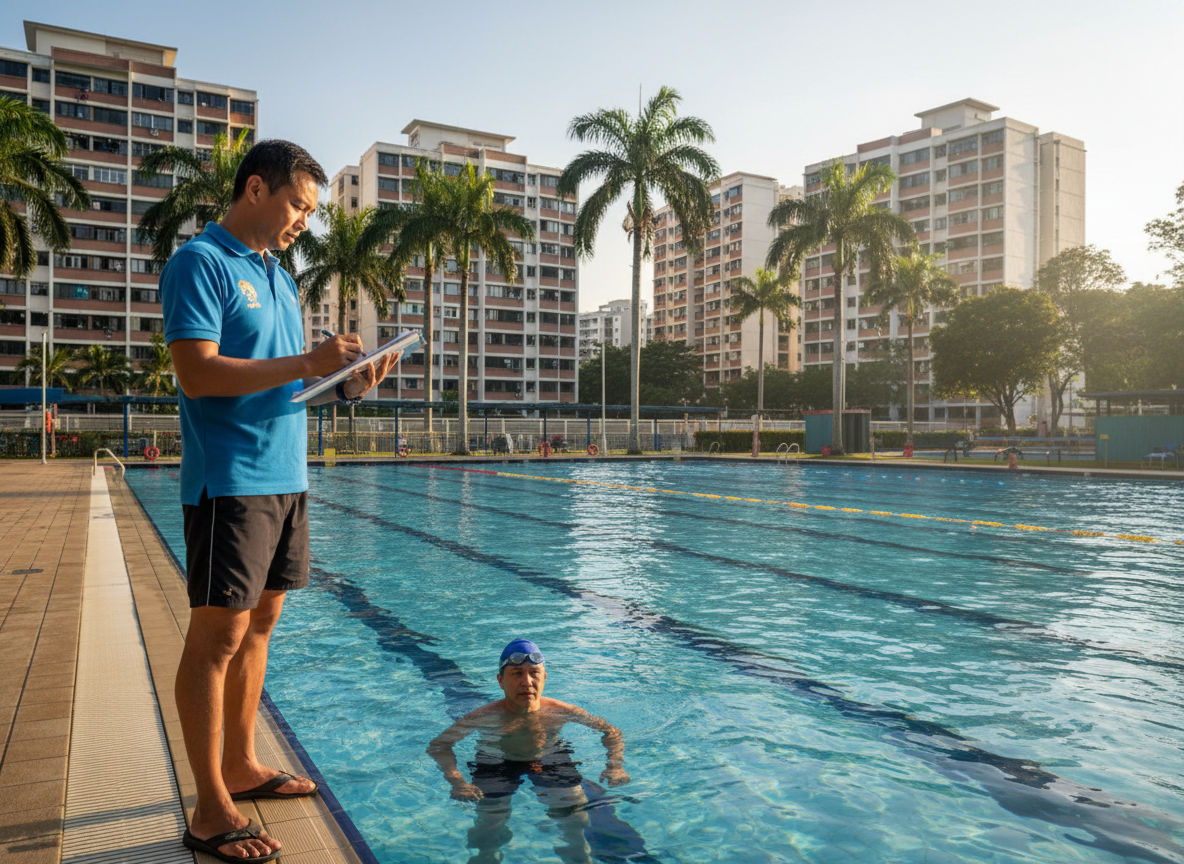
- Initial observation — your coach watches 2–4 lengths of your natural swimming without comment, assessing body position, arm entry and catch, pull mechanics, kick pattern, rotation, and breath timing simultaneously.
- Fault identification — from the observation, the coach identifies the 1–2 faults creating the most drag or costing the most propulsion. Addressing too many things at once slows progress; prioritisation is critical.
- Targeted drill work — specific drills isolate and correct each identified fault. Crossover entry? Fingertip drag drills. Sinking hips? Chest press and head position cues. Dropped elbow? Single-arm freestyle sets with pause at the front.
- Integration practice — after drilling, you swim normally while maintaining the corrected element. The coach watches for regression to old habits and gives real-time feedback.
- Video review (where available) — underwater video is the single most powerful stroke correction tool. Most swimmers are genuinely surprised by the gap between their imagined technique and what appears on screen.
- Consolidation sets — timed or distance sets that build the correction into the nervous system under mild fatigue, when technique tends to break down.
Stroke-by-Stroke: What Correction Involves
Freestyle
The most frequently corrected stroke in Singapore pools. Lifting the head to breathe — instead of rotating the body and keeping one goggle in the water — causes hips to sink and adds substantial drag. Fixing this one fault alone often produces dramatic improvement in body position and comfort. Arm crossing the centreline on entry, dropped elbow during the pull, and insufficient body rotation are the other top targets.
Breaststroke
The most technically complex stroke and the one most often self-taught incorrectly. Simultaneous arm-and-kick timing — rather than a sequential pull, glide, kick sequence — is the leading fault. A wide kick with feet splaying outward is second. Breaststroke correction typically requires more sessions than freestyle due to the precision of the timing sequence, but improvement is highly visible and satisfying when it clicks.
Backstroke
Often neglected by recreational swimmers, making it both the weakest stroke and the one with the most room for rapid improvement. Lateral body snaking from arm crossover, insufficient hip rotation, and a weak pull are the typical targets. Many swimmers find backstroke improves fastest once coaching begins — partly because there is no breath-timing complication.
Safety: Breath-Holding and Hypoxic Drills
Important safety notice: Some swimmers, particularly those training competitively, attempt extended breath-holding or hypoxic drills (repeated underwater laps with minimal breathing). These carry a genuine risk of shallow-water blackout — loss of consciousness due to low oxygen, occurring with no warning. Never practise breath-holding drills alone or without a qualified coach and a trained observer present. SwimmingCoach.sg coaches do not include hypoxic drills in recreational stroke correction sessions.
Who Benefits From Stroke Correction
Stroke correction suits any swimmer who can already complete a lap but wants to swim more efficiently, faster, or with less fatigue. It is particularly valuable for:
- Recreational swimmers who plateau and feel like they are working harder than they should
- Adults returning to the pool after years away, carrying self-taught habits
- Children who learned to swim but were never coached on technique
- Triathletes and open-water swimmers for whom swimming efficiency directly affects race results
- Fitness swimmers who want to extend their laps without increasing fatigue
Where to Do Stroke Correction in Singapore
Stroke correction works best where the coach can see every stroke clearly. Condo pool sessions are ideal — quiet, private, and shallow enough for the coach to stand at the edge and observe continuously. For public pool options across Singapore, see swimmingnearme.sg and swimmingcomplex.sg. For private pool arrangements, see privateswimming.sg and condoswimming.sg.
Broader resources: singaporeswimminglessons.sg, swimmingclasses.sg, swimminginstructorcourse.sg, specialneeds.com.sg, swimschoolsinternational.sg.
Frequently Asked Questions
How do I know if stroke correction will help me?
If you feel you are working hard for slow results, or if more relaxed swimmers consistently pass you, technique is almost certainly the limiting factor. A single assessment session will identify the issues clearly.
How many sessions does stroke correction take?
Minor adjustments may produce a noticeable change quickly; major technique rebuilds take longer. A fixed timeline cannot be promised without assessing the swimmer — progress depends on the specific fault, practice quality between sessions, and how consistently the correction is reinforced.
Can stroke correction be done in a group?
Small groups of 2–3 swimmers at similar levels work well and are more affordable. For highly individual faults, private sessions allow more direct observation and targeted feedback per stroke.
Will I be slower during the correction process?
Briefly, sometimes — new movement patterns feel unfamiliar before they feel natural. Most swimmers experience a short adjustment period, but the net performance gain typically follows once the pattern consolidates.
Is stroke correction only for adults?
No. Children’s technique is generally easier to correct than adults’ because movement habits are less ingrained. Catching and correcting faults early saves considerable retraining time later.
How do I book a stroke correction session?
Contact SwimmingCoach.sg to arrange a technique assessment. Certified coaches serve all areas of Singapore at your condo pool or a suitable nearby venue.
Swim Smarter, Not Just Harder
Every swimmer has a technique ceiling — a point where more training produces diminishing returns without technique improvement. Stroke correction breaks through that ceiling. Focused work with a certified coach identifies the changes that will make the most difference to how efficiently and comfortably you swim. Get in touch with SwimmingCoach.sg today.


[…] Stroke correction in Singapore […]
[…] Stroke correction in Singapore […]
[…] Private sessions are not only for beginners. Many competent recreational swimmers in Singapore plateau at the same comfortable pace and wonder why they are not getting faster or less tired. A private coach can do a proper stroke analysis and identify the two or three technical issues that are costing efficiency. Targeted correction at this level is almost impossible in a group setting. See also: stroke correction for Singapore swimmers. […]
[…] Stroke correction in Singapore […]
[…] Stroke correction in Singapore […]